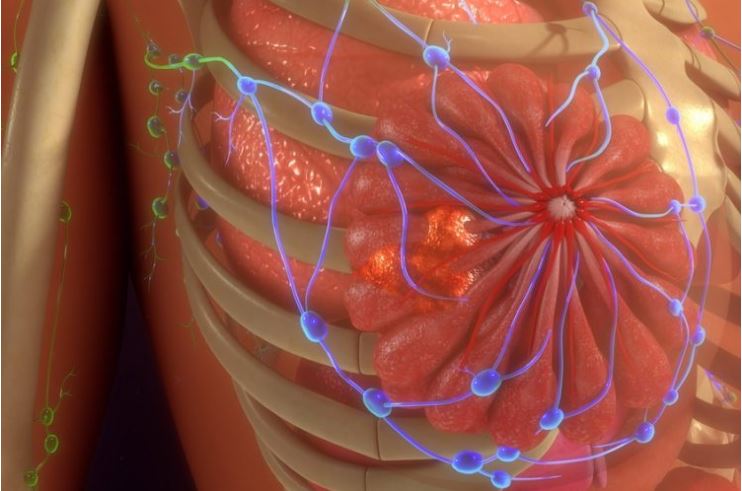
Breast cancer is the most widely recognized malignancy harassing ladies in the United States, paying little mind to race or ethnicity. The Centers for Disease Control and Prevention reports that 1 of every 8 ladies will be determined to have obtrusive Breast malignant growth in her lifetime. In 2013, in excess of 40,000 ladies and 464 men passed on of the disease. In 2017, in excess of 250,000 ladies and more than 2,000 men are required to be determined to have the ailment.
Buy Gutamin 7 for a good health.
Signs and Symptoms

Few out of every odd instance of Breast malignant growth will have signs and manifestations recognizable to the patient straight away. This is the reason routine screening, for example normally booked mammograms, are considered by numerous specialists to be basic to improving endurance paces of the malady. Notwithstanding, some Breast malignant growths do show themselves. On the off chance that you notice any of the accompanying signs, as laid out by the Memorial Sloan Kettering Cancer Center, see your primary care physician immediately:
“A knot or thickness in or close to the Breast or under the arm
Unexplained expanding or shrinkage of the Breast, especially on one side in particular
Dimpling or puckering of the Breast
Areola release (liquid) other than Breast milk that happens without pressing the areola
Breast skin changes, for example, redness, chipping, thickening or pitting that resembles the skin of an orange
An areola that gets depressed (reversed), red, thick or textured”
Hazard Factors
There are numerous components that add to whether you’ll create Breast malignant growth in your lifetime. The essential hazard for any disease is age – the more established you are, the more possibilities you’ll have a cell create hereditary transformations that could in the end develop into malignant growth. This is valid for Breast disease which influences more established ladies than it does more youthful ladies. The National Cancer foundation reports that the middle age at determination among Breast malignancy patients is 62 years.
Hereditary qualities have likewise been appeared to assume a job in whether you’ll create Breast malignant growth. Hereditary changes on the BRCA1 and BRCA2 quality have gotten a ton of consideration in the course of recent years or so just like the essential wellspring of hereditarily based instances of Breast malignant growth, however other hereditary transformations can likewise prompt the advancement of disease. Certain ethnicities, specifically Ashkenazi Jews, have a higher pace of BRCA1 and BRCA2 quality changes. A solid family ancestry of Breast, ovarian or prostate disease could likewise highlight a hereditary part and may lead you to seek after hereditary testing to show signs of improvement comprehension of your individual hazard.
Other individual varieties in the measure of estrogen your body produces and the span of that presentation can factor into whether you create Breast malignant growth. This is the reason your primary care physician will probably ask how old you were the point at which you began bleeding, when you entered menopause, regardless of whether you’ve had youngsters and whether you breastfed any kids you had. Taking anti-conception medication pills, getting pregnant sometime down the road or not getting pregnant at all may likewise somewhat build your danger of creating Breast malignancy. Studies have additionally demonstrated that presentation to specific synthetic substances in the earth, an absence of activity and less than stellar eating routine can assume a job in the advancement of Breast malignancy.
Determination
Mammography is the most widely recognized instrument presently used to analyze Breast disease. A mammogram is a X-beam of the Breasts that makes a picture that is then evaluated by a radiologist. This specialist is searching for suspicious bumps or developments that will appear as a more white spot against a darker foundation. The Susan G. Komen association reports that mammography has a 84 percent achievement rate. Other indicative devices include:
Advanced mammography. This is likewise a X-beam, yet the picture is rendered carefully as opposed to on film.
Advanced tomosynthesis. This device makes a three-dimensional picture, permitting the radiologist to see cross areas of the Breast, as opposed to the whole Breast at the same time.
Ultrasound. Ultrasound innovation utilizes sound waves to make pictures of the Breasts and any masses inside them without the utilization of radiation. It’s frequently utilized as a line up to a mammogram with an anomalous finding.
X-ray. Sub-atomic reverberation imaging utilizes attractive fields and radio waves to make a picture of the Breast. This is generally utilized uniquely as an auxiliary screening instrument in the wake of something strange appears on a mammogram.
Atomic Breast imaging. MBI utilizes an infused radioactive isotope to illuminate harmful developments on a picture made with an atomic camera. It has a higher achievement rate for discovering diseases in ladies with exceptionally thick Breasts, however a few concerns endure about the measure of radiation the patient’s body is presented to during the strategy.
Every methodology has its advantages and disadvantages, yet fortunately nowadays, there are a few unique ways your primary care physician can get an image of what’s moving on inside your Breasts that may help in the early conclusion of Breast malignant growth.
The U.S. Preventive Services Task Force at present prescribes that all ladies age 50 to 74 have a biennial screening mammogram. The American Cancer Society prescribes ladies of normal hazard start yearly screening at age 45. Neither gathering at present suggests that ladies lead month to month Breast self-tests, yet advocate that ladies ought to know about their Breasts and stay careful of any changes.
Stages
Likewise with different types of malignant growth, the seriousness and treatment of any individual instance of Breast disease is to some degree reliant on the phase at which it is analyzed. As an instance of malignant growth advances, the quantity of the stage increments, implying the amount it has developed or spread. Later-organize illness regularly associates to decreased endurance rates.
Stage 0. Stage 0 alludes to noninvasive Breast malignancies that have not developed past the piece of the Breast in which they began. Likewise called ductal carcinoma in situ, these strange developments are not in fact thought about malignancy and are regularly alluded to as precancers. Be that as it may, they do demonstrate an expanded danger of creating Breast malignant growth, and are normally treated with medical procedure or radiation. Chemotherapy isn’t normally part of the treatment convention, however might be shown in certain occurrences.
Stage 1. Stage 1 alludes to intrusive Breast malignancy, which means a disease that has started to develop past its place of cause, however is as yet contained inside the Breast. Stage 1 can be additionally isolated into subcategories An and B dependent on the size of the tumor and whether carcinogenic cells have been found in close by lymph hubs.
Stage 2. Stage 2 Breast tumors are developing yet are as yet contained inside the Breast and close by lymph hubs, yet will in general be bigger than most stage 1 malignancies. This stage is likewise broken into two subcategories, An and B, contingent upon the size of the tumor and whether disease cells have spread to lymph hubs.
Stage 3. Stage 3 is a progressed yet treatable type of Breast malignant growth that has spread past the prompt area of the tumor. Much of the time, the tumor may have attacked close by lymph hubs and muscles, yet hasn’t spread to inaccessible organs. This stage is additionally subdivided into three subcategories – A, B and C – relying upon the size of the tumor and the quantity of lymph hubs it has spread to.
Stage 4: Stage 4, additionally called metastatic Breast malignant growth, is the last phase of the malady. Breast malignant growths that have spread to far off organs – commonly the cerebrum, bones, lungs or liver – are portrayed as stage 4. It’s deadly, yet new treatments are expanding future inside this stage, and numerous patients deal with the malady as an incessant condition for quite a long time or years.
Types
A great many people consider Breast malignant growth as a solitary sickness, however truth be told, there are a few unique sorts of Breast disease you may wind up looking in your lifetime. They can be grouped into two general classifications: noninvasive and obtrusive. For noninvasive malignancy, the Cancer Treatment Centers of America site reports that “dangerous cells stay in a specific area of the Breast, without spreading to encompassing tissue, lobules or channels.”
With obtrusive Breast malignancies, “destructive cells get through typical Breast tissue boundaries and spread to different pieces of the body through the circulation system and lymph hubs,” reports Breastcancer.org, an instructive site. Obtrusive ductal carcinoma, in which malignant growth cells develop in the milk pipes, is the most well-known type of Breast disease, as indicated by the American Cancer Society.
Intrusive Breast malignant growths are additionally sorted by the shape and area of the tumor. Moreover, the malignant growth will be ordered dependent on how it is bolstered by the body, with most of Breast diseases being viewed as estrogen open (ER) – that is they’re sustained by estrogen.
Medicines
Since there are a wide range of kinds of Breast malignancy, the methodology your primary care physician takes to treating yours will be exceptionally individualized. Medicines can include:
Medical procedure. Your primary care physician may endorse a:
Lumpectomy, in which the dangerous tissue is expelled from the Breast however the greater part of the Breast is left flawless.
A mastectomy, where the whole Breast is expelled. The specialist may likewise expel some close by lymph hubs.
A reciprocal mastectomy, where the two Breasts are evacuated, alongside close by lymph hubs.
Radiation. Radiation treatment utilizes focused on, high-vitality light and X-beams to execute malignancy cells where they develop. It’s utilized in certain Breast malignant growth cases to slaughter disease cells, however not all.
Endocrine treatment. Endocrine treatment is medicate based routine that stifles the hormones that feed the malignant growth. Tamoxifen is one of the most regularly recommended enemy of estrogen drugs and a case of this sort of treatment.
Chemotherapy. Chemotherapy is a medication based method for murdering disease cells any place they might be in the body, and it’s infamous for having malicious reactions, for example, male pattern baldness and sickness. All things considered, chemotherapy can be an exceptionally successful, foundational method for freeing the assemblage of malignant growth. It’s occasionally utilized before medical procedure to recoil a tumor, or after to murder any malignant growth cells that may have been abandoned
 The Adviser